Wednesday, October 21, 2009

Two Potential Multimodal Project Types: The Infographic and the Prezi

Several things I see as important for choosing a multimodal composing project:
1. It must be something that can be taught largely through rhetorical principles.
2. It should have persuasive text (the written word) that interacts with visuals in some way.

Two forms of multimodal projects that I think would work for #1 and #3 of Brian's proposed assignment are the Infographic and the Prezi.

The Infographic

These come in all shapes and forms, and could be done in any program that can combine visuals with text.

This is related to traditional genres like the persuasive brochure, but intends to be a web document.

Some infographics are just informational; the best ones, however, are highly rhetorical.

An example:
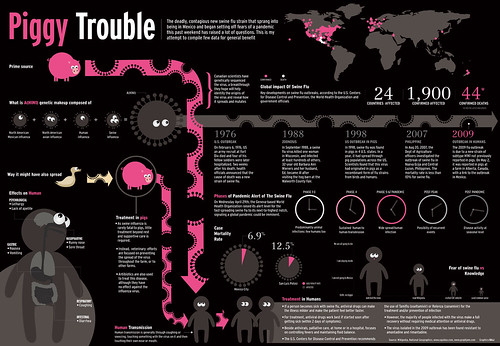


Go to this page (Piggy Trouble) for a bigger view.

Here's a link to a powerful one on Barack Obama's place in history.

The website Six Revisions has a post titled 40 Useful and Creative Infographics which you may want to check out.

Another site filled with infographics is Visual Economics.

The Prezi

The Prezi is a new type of presentation, with free software available to anyone. With any tool, you can make it more or less rhetorical.

Here's a Prezi that I made to help teach Topics of Invention to my English 150 students:


Just use the arrows for a preconstructed path through "Argument City."

The assignment: a first attempt

Multimodal Argument: Assignment Sheet and Grading Rubric

Task: In groups of 3-4, design an argument using rhetorical strategies in two different media in addition to writing. Use images, tables, graphs, charts, hyperlinks, audio or video clips, document design, animations, comment options, or other interactive media to enhance your argument and convince your audience. You may choose any appropriate, convincing medium for your message: a blog entry, brochure, webpage, formal proposal, or pamphlet. However, you must use at least 1000 words of text in your document and include at least 5 authoritative outside sources.

Select one of the following rhetorical situations to respond to with your multimodal argument:

1. President Samuelson has selected your group to represent BYU students on a panel discussing student issues. He has asked you to propose a change in policy that will influence campus life. Create a document that argues for such a change. You can propose a change in facility, technology, course offerings, campus amenities, or administrative procedures. You may suggest substantial changes in services or institutions, or you may want to propose a new program, organization, service, or institution that would benefit the university community.
2. You and your peers have decided you want to make the world a better place. Write an advocacy proposal for a new government-funded community project to confront a local need. In your document, you will explain why your project is needed in the community, what it might cost, and who will perform the labor. Consider other local and national programs that address the need and situate your organization within that broader context. You will write your document to a decision-maker in a specific branch or organization of the federal or local government that would oversee such a project.
3. You have just finished a researched issues paper for English 150. Perhaps someone in your group wrote about an issue that your group feels the rest of the class should know about. Take that argument and transform it into a multimodal argument addressed to your peers in this class.

Grading Rubric:

The “A” Multimodal Argument . . .

The “B” Multimodal Argument . . .